Tuesday, 7 June 2011

Batten down the hatches

The onset of wintery weather on Bird Island is a rather gradual affair. For most of the summer the air temperature hovered around 5°C, but it has been slowly falling over the last few months and is now hovering around 0°C. When it drops below zero for a few days in a row the whole island freezes up; the streams freeze solid, the ground turns to iron and the pools of mud become concealed by a layer of ice, which gives way when you step on it and plunges your leg into the cold goop below. Then a few days later the temperature will be back up to, say, 0.4°C and everything melts again.

The base with a light dusting of snow.

Icicles.

'Icle icicles.

The snowy mountains of South Georgia, seen through Natural Arch.

A geep wonders why swimming has suddenly become so difficult.

Frozen kelp.

Many of the summer residents of the island have now departed, to spend winter in the warmer waters to the north. The macaroni penguin colonies are empty, and we will not see another mac now until October (macs are very punctual – the chart on the wall by my desk says that they will come back on the 17th October and I have no doubt that they will be here on exactly that date). The gentoo penguins stay with us all winter though, and can be always be found loafing about on the beaches. Most of the fur seals have left, but there are always a few seals around to growl and huff at you as you walk past them. The cool winter weather also brings leopard seals further north, and these huge and fearsome predators often haul out on the beaches of Bird Island for a little snooze. Leopard seals can reach 3.5 metres in length and have teeth like an alligator, so a sleeping leopard seal is best left alone.

A gentoo, loafing.

The amazing two-headed, four-flippered penguin.

Seals enjoying their winter holidays.

Do not attempt to cuddle: a leopard seal.

A lep dozes by the jetty.
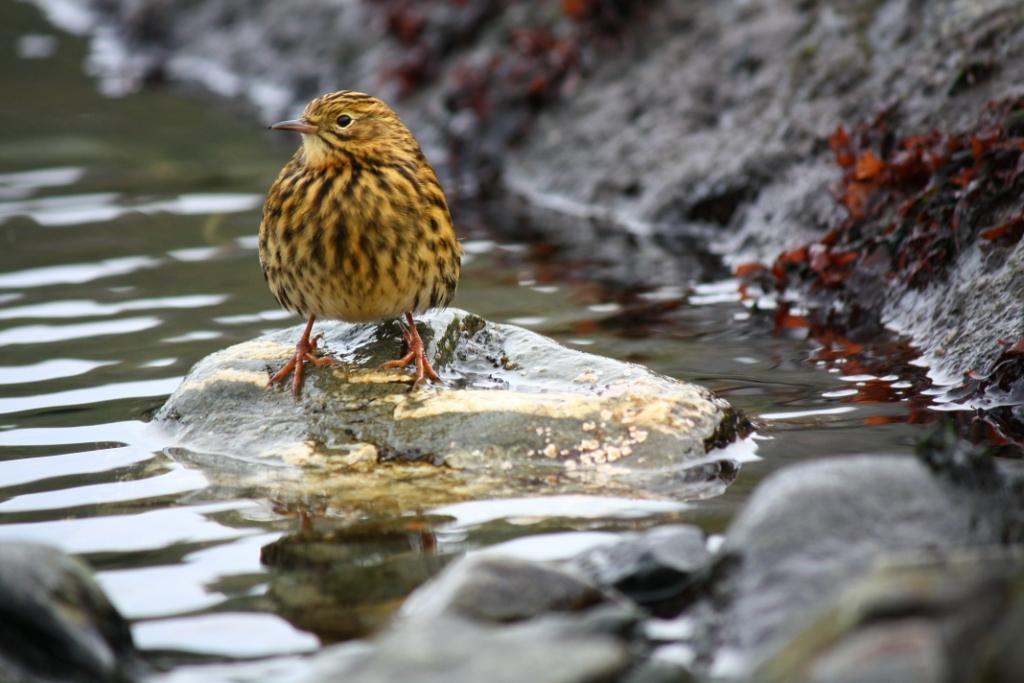
In winter the South Georgia pipits forage for little beasties on the seashore.

Cattle egrets get everywhere!

The black-browed and grey-headed albatross colonies are also emptying rapidly. Chicks began fledging in April and there are now only a few late-developers left. Like the macaroni penguins, the adult albatrosses disappear over winter and will not return until the start of next summer. Not so the wanderers, however. The wandering albatross chicks, which hatched at the beginning of winter, are now large enough to be left on their own, and consequently the island is covered in little, grey, fluffy bundles, perched on top of their pedestal nests. The adults return regularly to feed them a nutritious meal of semi-digested squid. Quite how these tiny, vulnerable chicks survive the onslaught of winter rain, snow and high winds remains a mystery to me.

Black-browed albatross chicks, looking indignant.

A black-brow chick, almost ready to go.

This is a rare 'isabelline' black-brow chick, it has a genetic mutation that makes it look like its been through the wash a few too many times.
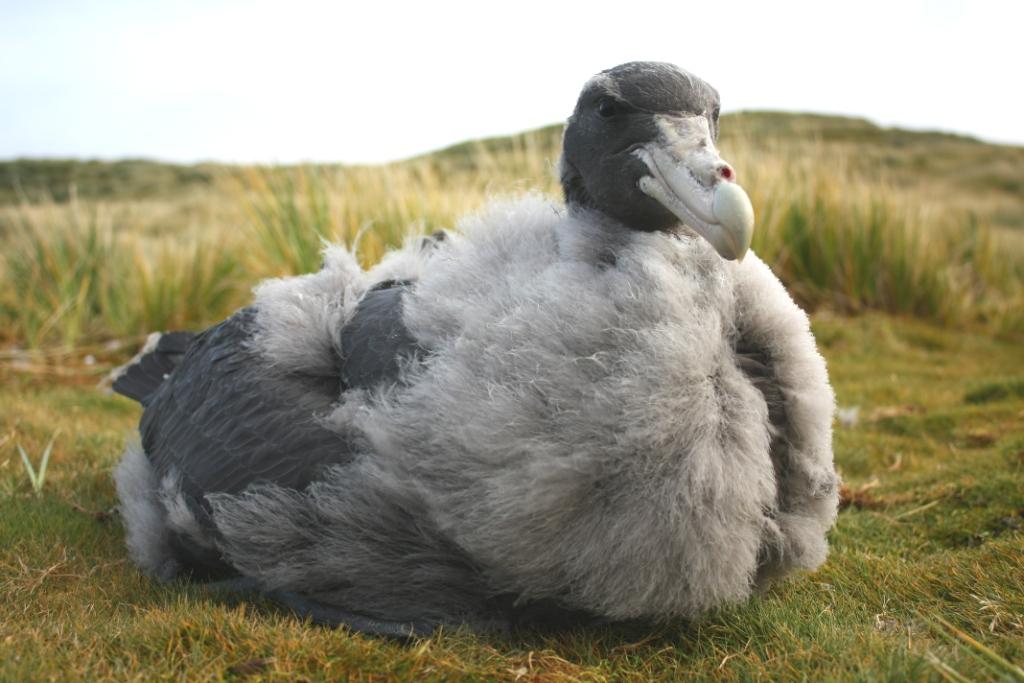
A grumpy, partially moulted giant petrel chick.

A fully-grown giant petrel chick begs for food from a less than enthusiastic adult. This chick fledged a couple of days later.

Even when not breeding, the geeps build 'practice' nests.

Wandering albatrosses literally put their kids on a pedestal.

A pair of wanderers, chillin'.

Sugar-frosted albatross chick.

Because there are fewer animals around the workload for us field assistants is significantly reduced compared to the summer months. Winter is therefore a time for us to catch up with some lab work. For me there are two main lab jobs to keep me busy. One is sorting all the beach debris that has been collected over the summer. Throughout the year we collect anything man-made that washes up on the beach at Main Bay, and then each item is weighed, measured and categorized, and the data is sent to CCAMLR (Convention on the Conservation of Antarctic Marine Living Resources) as part of a global programme monitoring how much trash there is floating around Antarctica. Most of what we find is plastic packaging and old fishing gear, but sometimes more unusual objects turn up. Last year a whole wooden chair appeared on the beach. My other lab job is analysing penguin diet samples that were collected in the summer. Any krill that were found in the samples have to be measured, aged and sexed by examining them under a microscope. Sexing and ageing a partially digested krill is no picnic, I can tell you, but after doing several hundred I think I’m getting better at separating the men from the boys, and indeed the boys from the girls.

Pieces of fishing line that washed up on the beach.

Some bits of beach debris are too big to collect. This young elephant seal is cuddled up to an enormous piece of timber that washed ashore.

A scientician, hard at work.

Anyone for prawn cocktail?

Three months into winter and our fresh fruit and veg supply is beginning to get a bit mouldy (it's a cabbage).

The same cabbage after some careful peeling. Amazingly it was still edible!

Another winter task, and one which everyone on base gets involved in, is the monthly census of wandering albatross nests. This involves counting every active nest on the island in a single day, and is big job when there are just four of us here to do it. Usually one person has to stay on base at all times, in case of an emergency, but on albatross census day this is not possible, so to reduce the risk of a fire starting while we are out and destroying the base we have to turn off the generators – meaning that the electricity, heating and communications all go off as well.


Our most recent albatross census day began quite nicely. We shut down the base and all went our separate ways to count albatrosses. The weather was pretty good – overcast as usual but dry and with very little wind, a perfect day for meandering around the island. However, after about three hours of tramping up and down hills looking for nests I was beginning to get a little tired, and the wind had started to pick up. I had reached a point where I needed to take a large detour to check on four nests that were outside the main colonies. The wind was getting stronger by the minute, but behind me at this stage, so I set off to find them. It was only when I turned round to head back to my original location that I realised just how ferocious the wind had become. Walking into it was difficult, and it had started to rain a sleety rain which lashed painfully into my face. I held my clipboard up in front of my face to shield me from the stinging rain and continued on. The clipboard arrangement was not ideal, however. Every so often the wind would catch hold of it and I would end up smacking myself in the face. It also made navigation rather more difficult and I soon became disorientated and ended up falling into a bog. Cursing, I pulled myself out and headed towards the final cluster of albatross nests that I needed to check. This last section was located on Wanderer Ridge Extension, and exposed headland that juts out into the sea. There are not many nests in this area, but there would also be no protection from the wind, which was now howling like some demented animal. I huddled momentarily in a sheltered spot to gather my strength and then gingerly climbed round the sheltered side of Wanderer Ridge Extension and emerged at the top into what appeared to be a hurricane. The wind ripped at my clothes and I was pummelled and pelted with rain. With every step I took I was knocked off balance and sent pitching into the tussock. There were treacherous muddy pools everywhere and it took all my strength to avoid being blown into them. The only option was to crawl everywhere on hands and knees. So in this way I clawed and floundered my way round the last few nests until finally, thankfully, they were all done.
I crouched in a ditch for a while to rest before attempting the walk home. Luckily I was not far from base and the journey back was made a little easier by walking along more sheltered streambeds. I half expected everyone else to be home already and me to receive a hero’s welcome as a hot mug of tea was pressed into my hand, but in fact I was the first one back and everyone else was still out in the maelstrom, and the lashing rain had now turned into lashing snow. I turned the generators back on and settled down to a restorative cup of tea. About half an hour later Mick turned up looking slightly shell-shocked.

“I was on Goldcrest Point when it hit...” he muttered, as though we had been receiving enemy fire rather than having a bit of a windy day.

He radioed the others to check that they were OK and suggested that they abandon the albatross census for today, an idea to which everyone readily agreed. We spent the rest of the afternoon drinking tea and swapping war stories, as the windows filled up by snow and the building quivered in the wind.

“I could hardly stand up!”

“The rain stung my eyes ‘til I couldn’t see!”

“I was so cold I couldn’t move my fingers!”

For once we felt like proper Antarctic heroes. Not quite in the same league as Amundsen and Shackleton of course, but brave and courageous, nonetheless, in the execution of our albatross counting duties.

Stormy winter seas.

The jetty on a snowy day.

Ice, ice baby.

Sunday, 24 April 2011

Puppy Parade

In the last week or so the fur seal puppies, who have been our constant companions since November, have suddenly disappeared, leaving the beaches around the island empty and silent. Everyone is sorry to see the puppies go, since puppy watching is one of our favourite pastimes. The first seal puppy appeared on Freshwater Beach (the beach in front of the base) on the 14th November and was quickly followed by dozens, then hundreds, then thousands more. Indeed, at peak pupping time around Christmas it was almost impossible to look out of a window without witnessing the miracle of birth. Labour for fur seals is very quick, with the pup usually popping out in a matter of minutes. Although a bit soggy and confused looking, new-born pups are immediately alert and mobile; no doubt the ability to get out of the way of rampaging harem males is hard-wired into their genes.

A new-born pup gets acquainted with its mother.

I *heart* my Mom.

Within a few hours of birth the puppies have dried off, had a nutritious milk meal and started to explore their surroundings. To begin with this is limited to the area immediately around Mom but they soon become more confident and go further afield, clambering over rocks and tussac, and playing with the neighbour’s kids. At this stage the puppies are almost indescribably cute. Little black bundles of fuzz with enormous blue eyes, butter-wouldn’t-melt faces, tiny droopy ears and outsize flippers which they constantly trip over. If cuteness were measured on a scale I’ve just invented based on the cuteness of kittens, then each puppy would measure roughly 1000 kittenpower. Most new-born puppies are jet black, but about 1 in 600 are born platinum blonde. These blonde seals stay blonde for their entire life, and we occasionally see fully grown blonde males and females on the island. And if you thought the black puppies were cute, the blondies are enough to reduce anyone, even hard-nosed technical services personnel, into a slushy, cooing, simpering mess.

You lookin' at me?

Puppy playfight.

Enormous, pleading eyes are the secret of puppy-appeal.

Scratching is a favourite pastime for puppies and adults alike.

These blonde puppies are cute, but so difficult to keep clean.

Moms and pups stay together on the beach for about 10 days, after which time the females go back out to sea to feed and periodically return to suckle their offspring. This presents the females with a challenge – if the beach has, say, 1000 identical black puppies cavorting on it, how do you know which one is yours? The female seals overcome this problem using a vocalization which I like to call the ‘bellow-shriek’. When a female emerges from the sea she immediately starts to holler at the top of her lungs; a sound which lies somewhere between ‘fox being strangled’ and ‘massacre at a yodelling competition’. She then wanders around the beach and tussac, hollering continuously, until she hears her puppy reply. The puppies respond with a kind of bleating/mewling noise, and presumably both Mom and pup produce a unique noise with which they can identify one another. Once re-united, the female and puppy continue to bellow at each other for a while, just to make sure, before settling down for dinner and a nap. Throughout the summer months the beach and surrounding hillsides echo with the howling cries of female seals and their pups. The sound does not seem to abate at night, indeed it seems to intensify. On more than one occasion I have been wrenched from the blissful depths of sleep by the banshee-like wailing of a female seal directly outside my window, an experience I don’t think I will ever get used to.

The bellow-shriek in action.

As the puppies get older they also get bolder, and develop an insatiable curiosity. The base and outbuildings are basically like a big adventure playground to them; anything that can be climbed on is climbed on, anything that can be hidden under is hidden under and anything that can be crawled through is crawled through. If you leave a door open for more than a few seconds then the building will be invaded by puppies. At various times over the summer I have had to herd puppies out of the generator shed, the food store, the porch and the kitchen. The walkways around the buildings are a favourite sleeping platform for them, being flat, rock-free and relatively dry, and we constantly have to move puppies from around the doors in order to get through them. Puppies start to swim from an early age, although they stick to the sheltered bays and large rockpools to begin with. These areas are always choc-full of puppies, hundreds at a time, leaping, splashing and charging about with exuberant energy, and resemble nothing more than a lido full of children on a hot summer’s day.

A puppy investigates.

Spending some quality time with the puppies.

I call this position 'upward facing seal'.

Andrex puppies.

 
 Stacey clears a path to the door.

 
Playtime at the pool.

Naps can happen at any moment.

In January, February and March a sample of fur seal puppies are weighed as part of the ongoing monitoring program on the island. Each month weights are collected for 50 beach puppies and 50 tussac puppies on Main Bay – tussac puppies weighing on average slightly more than beach puppies. Catching 100 puppies is hard work so everyone on base is roped into this activity, with two people weighing and recording data, and the rest chasing down puppies and bringing them back to the weighstation. In January puppy weighing is reasonably easy, since the pups are still fairly small and docile at that stage. By March they are much bigger, faster, angrier and bitier, making the whole process a lot more taxing. Carrying a 15kg puppy which is writhing and struggling and trying to sink its teeth into your leg gives you a full cardio-vascular workout, and by the end of the weighing session everyone is exhausted and mud-spattered.

Pre-puppy weighing;  Ags, Paul, me, Joan, Jon.

Post-puppy weighing; Jon, Paul and Joan.

 Post-puppy weighing; me, Stacey Ags. They say the people who did the most work end up the dirtiest, but I don't believe that.

By mid-March all of the puppies have moulted out of their black baby fur into a sleek silver-grey coat, and their numbers have started to diminish as they head out to sea to begin their adult life. By mid-April there are almost no puppies to be seen anywhere. We are not completely seal-less, however. There are always a few females lounging on the beach and in the tussac, and the occasional widge (juvenile seals aged 1-2 years) and young male also turns up. But the puppy parade is over for this season, and we will have to wait another seven months before it starts all over again.

Submarine puppy.

Fighting is still playful, but preparation for the real thing in later life.

Looking sleek and mean in a new silvery coat.

Playing with a feather whilst sitting in a pool. What could be more fun?

Thursday, 31 March 2011

Now we are four

On Sunday 27th March the RRS Ernest Shackleton parked itself in front of Bird Island to undertake 'last call', the last ship visit we will have before the onset of winter. As well as taking away all the people who are not wintering, the Shack was also dropping off some supplies and removing all our rubbish and unnecessary equipment. The ship's crew had predicted that the whole operation would take around two hours, and so eleven hours later when we were still loading cargo, we reflected on how unpredictable boating operations can be.

Last call draws a line between the summer and winter seasons on Bird Island. Of course there have already been signs that winter is approaching - the nights are getting longer, the weather is getting colder, the animals are starting to leave - but after last call we are reduced to a winter crew of just four people, and there will be no more ship visits until September; it really feels like there has been a big change. We are also waving goodbye to some good friends. I will particularly miss Ags, our stalwart Base Commander and my roommate since November, and Stacey, the outgoing penguin assistant who has been training me all summer. Stacey has been here for two and a half years, and takes with her a vast amount of knowledge about Bird Island. Those are some mighty big penguin assistant shoes I now have to fill.

It's hard to believe that summer is over already, and the carnival of reproduction on the island is coming to an end. There are still lots of animals around but more and more leave every day. The gentoo and macaroni penguin chicks are all gone, the giant petrels are fledging and the fur seal pups are disappearing. We will not be completely alone in the winter though; for the last month or so wandering albatross chicks have been popping out of eggs all over the island, and they will be with us through the long, dark, snowy months, sitting resolutely on their nests. It's a crazy breeding strategy if you ask me, but I guess they know what they are doing.

But for now we are trying to get used to an eerily quiet base, and having to cook every four days, and not having Stacey or Ags around whenever we have a dumb question about anything. There is an overwhelming sense that all the grown-ups have gone out and left us kids home alone. Can we cope, or will it all go a bit 'Lord of the Flies'? Tune in in six months time to find out.

Team Bird Island as it was : (back row from left) Stacey, Andy, Jen, Paul, Chris, Ags, (front row) Mick and myself.

Final goodbye. Stacey (purple hat) has not left the island for two and a half years and understandably looks a little shell-shocked.

The Ernest Shackleton steams away.

Team Bird Island as it is now: Mick (Winter Base Commander / seal assistant), Paul (technical services), Jen (albatross assistant),  me (penguin assistant).

Tuesday, 15 February 2011

Professional Penguin Wrangler

‘Just what does a Professional Penguin Wrangler do all day?’ is a question that literally tens of people have asked me. My duties, penguin-wise at least, mostly fall into three categories: counting penguins, weighing penguins and sticking stuff onto penguins.

1. Counting penguins.

There are two species of penguin that breed on Bird Island, the gentoo penguin and the macaroni penguin. In order to guage the health of the penguin populations, and ultimately the health of Antarctic ecosystems in general, it is important to know how many penguins are breeding in a given year, and this means counting them at various stages of the breeding cycle. Counts are done at several penguin colonies during build-up (when the penguins arrive and claim a nest site), after all eggs have been laid and finally just before the chicks fledge. Build-up had already passed by the time I arrived on Bird Island, so my first penguin counting experience was a nest count of macaroni penguins at Big Mac colony. Big Mac, as the name suggests, is very big, housing around 40,000 pairs of penguins in any given year. Counting all of them would be impossible, so instead we estimate the total number by counting all the penguins in two ten-metre wide transects that run from the top to the bottom of the colony. The transects are marked out with yellow stones and divided into 5x5m squares, with each square being counted in turn to give the total.

On my first penguin counting day, the 30th November, the weather was grim – windy, raining and cold – so by the time Stacey and I reached Big Mac we were already rather soggy and dejected. Big Mac is steep and made up of rocks and loose rocky shale, and the rain had made it slicker than an ice rink. It was also completely covered in angry penguins. We edged our way gingerly down to the bottom, trying not to slip, with the penguins honking their disapproval at us on all sides. At this stage the macs had just laid their eggs and both birds from each pair were hanging around at the nest, creating an extremely high penguin density. Since every vaguely flat crevice was occupied by a penguin sitting on an egg, there were few stable footholds, so I slithered and stumbled my way up to the first set of yellow rocks with furious penguins pecking at my ankles the whole way. At the top of the first quadrat we turned around and counted the nests in it. ‘Twenty-eight,’ Stacey yelled at me over the cacophony of penguins. ‘Thirty-six,’ I bellowed back. We counted again. The cold began to penetrate my clothes.The rain had not abated and even the penguins looked wet and miserable, hunched over their eggs. On the third count we both got the same number, and were able to move on to the next quadrat. More slipping and sliding and, at times, crawling along on my hands and knees through the hordes of angry penguins. And so it went on until, 24 quadrats later, we reached the top; cold, wet, bedraggled and caked in penguin guano. We immediately moved on to the second transect, and by the time we had finished it I had lost all feeling in my hands and had developed a deep loathing for penguins, rain, the person who devised these transects and Antarctica in general. Fortunately there was a field hut nearby, and after a fortifying cup of tea I felt much more cheerful and decided that I didn’t hate penguins after all, which is lucky really, given what my job is.

There are 80,000 penguins at Big Mac colony. Fortunately we don't have to count all of them.

Counting gentoo chicks is a team effort.

2. Weighing penguins.

Another indicator of the health of penguin communities is the average weight of the penguins. In years when there is a lot of food available penguins will be fatter, and fat, healthy penguins are more likely to be able to raise their chicks to fledging. The weight of the chicks just before they fledge is also a good indicator of whether they will survive the winter, and thus provides information on annual survival rates. The traditional way to weigh a penguin is to grab it, shove it into a bag and weigh it using a pesola spring balance. However one of my jobs here on Bird Island is to look after the penguin weighbridge, an ingenious device created by the boffins at BAS, which allows automated penguin weighing.

The penguin weighbridge is situated beside Little Mac, a small macaroni penguin colony that contains around 400 nests. The location of Little Mac means that all the penguins, when walking to and from the sea, pass through a narrow bottleneck of land, and this is where the weighbridge has been placed. It is simple enough in theory – the penguin steps onto a weighing platform, its weight is recorded and then it steps off again. In practice it is much harder to obtain accurate weights in this way since measuring the weight of a moving, hopping penguin is a very difficult thing to do. Imagine trying to record the weight a person who was jumping up and down on the weighing scales and you begin to understand the difficulty. If we could somehow persuade the penguins to get onto the weighing platform one at a time and stand still for a few seconds before getting off then the whole thing would be much easier, but alas, the penguins are not this co-operative. Nevertheless, after several years of development and using insanely complicated algorithms, the BAS weighbridge now works extremely well and can accurately weigh a moving penguin to within a few tens of grams. The exact design of the bridge is top secret because, astonishingly, there is more than one group of scientists working on automatic penguin weighing and we don’t want our competitors to steal our ideas.

Catching a wily macaroni penguin.

Weighing a penguin the old-fashioned way.

Stacey demonstrates the 'handbag' method for carrying a penguin.

 As well as weighing the penguin, some vital statistics are taken.

Some macs contemplate crossing the weighbridge.

One at a time, please!

Safely across.

3. Sticking stuff onto penguins.

This summer there is a tracking study being carried out on the gentoo penguins, which involves attaching GPS logging devices to individual birds to find out where they go whilst at sea, and also Temperature-Depth-Recorders to find out where and how deeply they dive. Deploying the devices on incubating birds is fairly straightforward. It is just a case of ambling along to the colony, choosing a penguin that is about to switch places with its partner on the nest, waiting for the changeover to happen and then grabbing the partner and attaching the devices before it heads out to sea. Attaching the devices is a two person job. One penguin wrangler catches the penguin with a net and places a hood over its head, making it look like a tiny little kidnap victim. The penguin is then restrained by straddling it with its head facing out the back, holding its feet with both hands and pressing the flippers against its body using your knees. This gives the second penguin wrangler access to the penguin’s back, where the devices are attached using a combination of tape, glue and cable-ties. The penguin then has a number painted onto its chest using black hair dye (which will disappear when the penguin moults later in the season), making it easier to identify, and is released. Job done and home in time for tea. However, when the devices need to be retrieved a few days later there is no choice but to go to the colony and wait for the particular tagged penguins to return. Penguins don’t keep to strict timetables, and device retrieval, we soon discovered, can involve waiting for up to six hours in the icy cold, silently willing the next penguin that comes out of the sea to be the one with a number on its chest. The study is thankfully now complete, and there are fourteen numbered penguins running around the island somewhere. I believe some of them have got together and will be playing a team of chinstraps next month in the South Georgia all-Penguin Amateur Football Championships.

Restraining the penguin.

Attaching a GPS datalogger.

Logger and TDR, securely attached.

Penguin wranglers love their work.

The final indignity - an ID number on the chest.

Penguin number 1, now playing centre-forward.

4. Some pictures unrelated to the text but still featuring penguins.

A partially moulted gentoo chick.

Large gentoo chicks relentlessly pursue the adults, begging for food.

Obi-wan has taught you well, but you are not a penguin wrangler yet.

Actually it is a device for reading the electronic implants which some of the penguins have.

A macaroni penguin with its chick.

The dangers of falling over when you are still fluffy.

Relaxing on a sunny day.

This penguin wrangling business is a piece of cake.